OK, I think I have a solution which is comfortable enough. The idea behind was that I take the service stream in pass profile, because it works always, also after switches. Recode this stream to a video which is flat and easy, and mux it back to TVH as external IPTV.
It works!!!
I use VLC player in the background because it is very stable within PMT changes, absolutely no freezes when ORF2 channels come to another regional stream. player is started and ended by a python wrapper. This wrapper runs on port 8800. Save it and start it as systemd or on command line (for testing). Touch Log file (/var/log/orf_vlc_wrapper.log) and add user (orfwrap, ...).
ORF VLC Wrapper (Important! Correct the service IDs according to your TVH installation!!). Run it under the new user you added (there are several dependencies, so stay calm;-)
#!/usr/bin/env python3
import os
import sys
import time
import signal
import socket
import logging
import threading
import subprocess
from http.server import ThreadingHTTPServer, BaseHTTPRequestHandler
from typing import Dict, Optional, Set, Tuple
# -------------------------
# Config
# -------------------------
BIND_HOST = "0.0.0.0"
BIND_PORT = 8800
LOG_FILE = "/var/log/orf_vlc_wrapper.log"
# If False: log lines will be "YYYY-mm-dd HH:MM:SS,ms <message>" (no INFO/ERROR)
# If True: log lines will include level "INFO/ERROR"
LOG_INCLUDE_LEVEL = False
# Keep Python internal logging level at INFO; errors still appear as ERROR.
LOG_LEVEL = logging.INFO
# TVHeadend base stream (pass profile)
TVH_BASE = "http://127.0.0.1:9981/stream/service"
TVH_PROFILE = "pass"
# VLC
VLC_BIN = "/usr/bin/cvlc"
VLC_PLUGIN_PATH = "/usr/lib/x86_64-linux-gnu/vlc/plugins"
# Stop VLC after this many seconds without any client connected to that endpoint.
IDLE_STOP_SECONDS = 20
# If we don't get bytes from VLC for this long while clients exist, restart VLC.
STALL_SECONDS = 15
# Socket read chunk size from VLC stdout
READ_CHUNK = 188 * 50 # ~ 9.4KB
# ORF2 service UUIDs
SERVICES = {
"/orf2k.ts": ("ORF2K HD", "62b2d62afef48b374003b91d03341959"),
"/orf2st.ts": ("ORF2St HD", "1c991f2fcf9ec1e6f25de43ec84c91bc"),
"/orf2b.ts": ("ORF2B HD", "0e86eecf524585e6fe8bb27d9bbe05ec"),
"/orf2o.ts": ("ORF2O HD", "a02a4f4168239be22b4e2070c4027cc3"),
"/orf2s.ts": ("ORF2S HD", "c8187e84cfc1af8bcd94a2f5913d61b7"),
"/orf2t.ts": ("ORF2T HD", "be6e1693dc15631ed4194a3ff76e4e3f"),
"/orf2v.ts": ("ORF2V HD", "e1d798361dee619fc2a7a28d0946a8cb"),
"/orf2n.ts": ("ORF2N HD", "920b04e52ac34b3b0d99775420d9446e"),
"/orf2w.ts": ("ORF2W HD", "10ef17c5bcc0c9e44a22cd673d1facd4"),
}
# -------------------------
# Globals
# -------------------------
SHUTDOWN_EVENT = threading.Event()
# -------------------------
# Logging
# -------------------------
logger = logging.getLogger("orf_vlc_wrapper")
logger.setLevel(LOG_LEVEL)
if LOG_INCLUDE_LEVEL:
fmt = logging.Formatter("%(asctime)s %(levelname)s %(message)s")
else:
fmt = logging.Formatter("%(asctime)s %(message)s")
fh = logging.FileHandler(LOG_FILE)
fh.setFormatter(fmt)
logger.addHandler(fh)
# keep console output minimal; can be removed if you want file only
sh = logging.StreamHandler(sys.stdout)
sh.setFormatter(fmt)
logger.addHandler(sh)
# -------------------------
# HTTP server class
# -------------------------
class DaemonThreadingHTTPServer(ThreadingHTTPServer):
daemon_threads = True
allow_reuse_address = True
# -------------------------
# VLC Stream Worker
# -------------------------
class VLCStream:
"""
One on-demand VLC pipeline per endpoint.
Multiple HTTP clients can subscribe; VLC starts when first client arrives.
VLC stops after idle timeout.
"""
def __init__(self, path: str, service_name: str, service_uuid: str):
self.path = path
self.service_name = service_name
self.service_uuid = service_uuid
self._lock = threading.Lock()
self._clients: Set[socket.socket] = set()
self._proc: Optional[subprocess.Popen] = None
self._reader_thread: Optional[threading.Thread] = None
self._last_client_left_ts = 0.0
self._last_bytes_ts = 0.0
def tvh_url(self) -> str:
return f"{TVH_BASE}/{self.service_uuid}?profile={TVH_PROFILE}"
def _build_vlc_cmd(self) -> Tuple[Dict[str, str], list]:
env = os.environ.copy()
env["VLC_PLUGIN_PATH"] = VLC_PLUGIN_PATH
# VLC: input TS -> remux TS to stdout (dst=-)
cmd = [
VLC_BIN,
"-I", "dummy",
"--demux", "ts",
"--no-video-title-show",
"--quiet",
"--network-caching=150",
self.tvh_url(),
"--sout", "#standard{access=file,mux=ts,dst=-}",
"--sout-keep",
]
return env, cmd
def _start_vlc_locked(self) -> None:
if SHUTDOWN_EVENT.is_set():
return
if self._proc and self._proc.poll() is None:
return
env, cmd = self._build_vlc_cmd()
try:
# start_new_session=True -> own process group, so we can kill the whole group
self._proc = subprocess.Popen(
cmd,
stdout=subprocess.PIPE,
stderr=subprocess.PIPE,
env=env,
bufsize=0,
start_new_session=True,
)
self._last_bytes_ts = time.time()
logger.info("%s starting VLC for %s (%s)", self.path, self.service_name, self.service_uuid)
self._reader_thread = threading.Thread(target=self._reader_loop, daemon=True)
self._reader_thread.start()
threading.Thread(target=self._stderr_drain, daemon=True).start()
except Exception as e:
logger.error("%s failed to start VLC: %s", self.path, e)
self._proc = None
def _stop_vlc_locked(self) -> None:
proc = self._proc
if not proc:
return
if proc.poll() is not None:
self._proc = None
return
logger.info("%s stopping VLC (idle or shutdown)", self.path)
try:
# kill whole process group
try:
os.killpg(proc.pid, signal.SIGTERM)
except Exception:
proc.terminate()
try:
proc.wait(timeout=3)
except subprocess.TimeoutExpired:
try:
os.killpg(proc.pid, signal.SIGKILL)
except Exception:
proc.kill()
except Exception as e:
logger.error("%s error stopping VLC: %s", self.path, e)
finally:
self._proc = None
def close_all_clients(self) -> None:
with self._lock:
clients = list(self._clients)
self._clients.clear()
for c in clients:
try:
c.shutdown(socket.SHUT_RDWR)
except Exception:
pass
try:
c.close()
except Exception:
pass
def add_client(self, sock: socket.socket) -> None:
with self._lock:
self._clients.add(sock)
self._last_client_left_ts = 0.0
self._start_vlc_locked()
def remove_client(self, sock: socket.socket) -> None:
with self._lock:
if sock in self._clients:
self._clients.remove(sock)
if not self._clients:
self._last_client_left_ts = time.time()
def _broadcast(self, data: bytes) -> None:
dead = []
with self._lock:
for c in list(self._clients):
try:
c.sendall(data)
except Exception:
dead.append(c)
for c in dead:
try:
self._clients.remove(c)
except KeyError:
pass
try:
c.close()
except Exception:
pass
if not self._clients and self._last_client_left_ts == 0.0:
self._last_client_left_ts = time.time()
def _reader_loop(self) -> None:
while not SHUTDOWN_EVENT.is_set():
with self._lock:
proc = self._proc
clients = len(self._clients)
last_left = self._last_client_left_ts
if not proc:
return
# idle stop
if clients == 0 and last_left and (time.time() - last_left) >= IDLE_STOP_SECONDS:
with self._lock:
self._stop_vlc_locked()
return
if clients == 0:
time.sleep(0.2)
continue
try:
chunk = proc.stdout.read(READ_CHUNK) if proc.stdout else b""
except Exception:
chunk = b""
if chunk:
self._last_bytes_ts = time.time()
self._broadcast(chunk)
continue
# no bytes
if proc.poll() is not None:
rc = proc.returncode
# rc=0 can be normal (stop path), so keep it INFO
if rc == 0:
logger.info("%s VLC exited rc=0", self.path)
else:
logger.error("%s VLC exited rc=%s", self.path, rc)
with self._lock:
self._proc = None
return
# stall -> restart
if (time.time() - self._last_bytes_ts) > STALL_SECONDS:
logger.error("%s VLC stalled, restarting", self.path)
with self._lock:
self._stop_vlc_locked()
if self._clients and not SHUTDOWN_EVENT.is_set():
self._start_vlc_locked()
time.sleep(0.2)
else:
time.sleep(0.05)
def _stderr_drain(self) -> None:
with self._lock:
proc = self._proc
if not proc or not proc.stderr:
return
try:
for line in iter(proc.stderr.readline, b""):
if SHUTDOWN_EVENT.is_set():
break
if not line:
break
msg = line.decode("utf-8", errors="replace").rstrip()
if msg:
# Treat VLC stderr as ERROR because you asked for error-level only
logger.error("%s vlc[%s] %s", self.path, proc.pid, msg)
with self._lock:
if self._proc != proc:
break
except Exception:
return
# -------------------------
# HTTP Handler
# -------------------------
STREAMS: Dict[str, VLCStream] = {
path: VLCStream(path, name, uuid)
for path, (name, uuid) in SERVICES.items()
}
class Handler(BaseHTTPRequestHandler):
protocol_version = "HTTP/1.1"
def do_GET(self):
if self.path not in STREAMS:
self.send_response(404)
self.send_header("Content-Type", "text/plain")
self.end_headers()
self.wfile.write(b"Not Found\n")
return
stream = STREAMS[self.path]
self.send_response(200)
self.send_header("Content-Type", "video/MP2T")
self.send_header("Cache-Control", "no-store")
self.send_header("Connection", "close")
self.end_headers()
sock = self.connection
sock.setsockopt(socket.IPPROTO_TCP, socket.TCP_NODELAY, 1)
sock.settimeout(1.0) # critical: do not block forever
stream.add_client(sock)
try:
while not SHUTDOWN_EVENT.is_set():
try:
data = sock.recv(1)
if not data:
break
except socket.timeout:
continue
except Exception:
pass
finally:
stream.remove_client(sock)
try:
sock.close()
except Exception:
pass
def log_message(self, format, *args):
return
# -------------------------
# Main
# -------------------------
def main():
logger.info("Starting orf_vlc_wrapper on %s:%d", BIND_HOST, BIND_PORT)
httpd = DaemonThreadingHTTPServer((BIND_HOST, BIND_PORT), Handler)
def _shutdown(signum, frame):
if SHUTDOWN_EVENT.is_set():
return
SHUTDOWN_EVENT.set()
logger.info("Shutdown requested")
# stop accepting new connections
try:
httpd.shutdown()
httpd.server_close()
except Exception:
pass
# close clients + stop vlc
for s in STREAMS.values():
try:
s.close_all_clients()
except Exception:
pass
with s._lock:
s._stop_vlc_locked()
signal.signal(signal.SIGTERM, _shutdown)
signal.signal(signal.SIGINT, _shutdown)
try:
httpd.serve_forever()
except KeyboardInterrupt:
_shutdown(signal.SIGINT, None)
if __name__ == "__main__":
main()
Possible systemd unit example:
# /etc/systemd/system/orf_vlc_wrapper.service
[Unit]
Description=ORF2 VLC wrapper (on-demand HTTP TS proxy)
After=network-online.target
Wants=network-online.target
[Service]
Type=simple
User=orfwrap
Group=orfwrap
ExecStart=/usr/bin/python3 /usr/local/bin/orf_vlc_wrapper.py
# Robust restart behaviour
Restart=always
RestartSec=2
# Ensure VLC has writable “home/config/cache” (fixes: Home directory not accessible)
StateDirectory=orfwrap
Environment=HOME=/var/lib/orfwrap
Environment=XDG_CONFIG_HOME=/var/lib/orfwrap/config
Environment=XDG_CACHE_HOME=/var/lib/orfwrap/cache
# Allow writing the log file
ReadWritePaths=/var/log/orf_vlc_wrapper.log
# Make stop/restart deterministic even if something blocks
TimeoutStopSec=10
KillMode=control-group
SendSIGKILL=yes
# Hardening (safe for this workload)
NoNewPrivileges=true
PrivateTmp=true
ProtectSystem=strict
ProtectHome=true
ProtectKernelTunables=true
ProtectKernelModules=true
ProtectControlGroups=true
RestrictSUIDSGID=true
LockPersonality=true
MemoryDenyWriteExecute=true
RestrictRealtime=true
RestrictNamespaces=true
# Minimal capabilities / syscalls
CapabilityBoundingSet=
AmbientCapabilities=
SystemCallArchitectures=native
[Install]
WantedBy=multi-user.target
systemctl daemon-reload
systemctl enable --now orf_vlc_wrapper
systemctl restart orf_vlc_wrapper
The result is a wrapper server which gives you an easy and flat stream. I do not recode, so your CPU should be ok. Take your servername or IP.
http://tvheadend.lan:8800/orf2b.ts
http://tvheadend.lan:8800/orf2w.ts
http://tvheadend.lan:8800/orf2o.ts
http://tvheadend.lan:8800/orf2k.ts
http://tvheadend.lan:8800/orf2n.ts
http://tvheadend.lan:8800/orf2st.ts
http://tvheadend.lan:8800/orf2s.ts
http://tvheadend.lan:8800/orf2t.ts
http://tvheadend.lan:8800/orf2v.ts
Use theses URLs to add 9 IPTV Muxes in TVH. After a scan you should have one stream within every MUX.
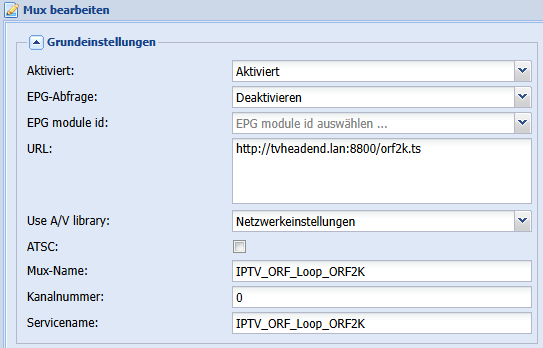
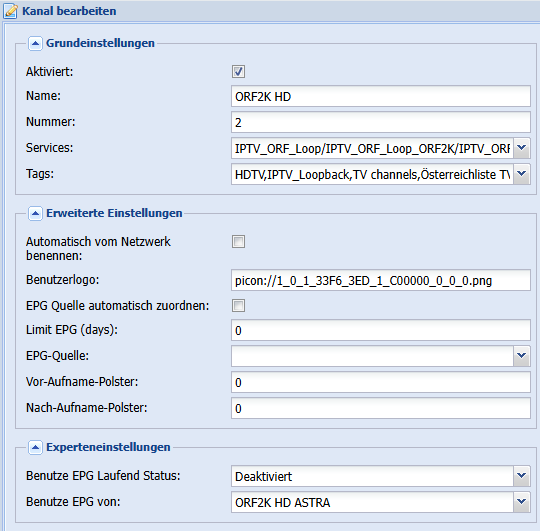
Rename the Astra channels so that you can make new Channels, with the original names. Add the new loopback services as service. Mind the EPG - just use the Astra EPG, works! Add Logo.
Drink beer now!